Ontario ranks last in Canada for roadside zoo protections as Québec downgraded following investigation
Canada NewsWire
TORONTO, May 14, 2026
World Animal Protection Canada calls for urgent provincial reforms to protect captive wildlife
TORONTO, May 14, 2026 /CNW/ - Ontario remains the worst province in Canada for captive wildlife regulations, while Québec has been downgraded in a key regulatory category following a Radio-Canada Enquête investigation that exposed serious concerns about the province's zoo oversight system.
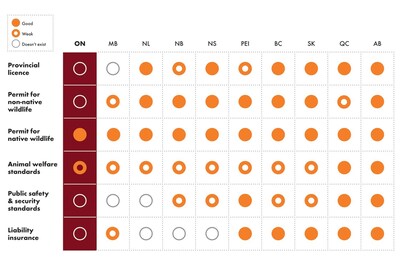
World Animal Protection Canada's updated provincial roadside zoo scorecard underscores that Canada continues to rely on a patchwork of inconsistent and inadequate rules governing the keeping, breeding and display of wild animals in captivity. While several provinces have taken stronger action, Ontario continues to stand apart for the wrong reasons: it has no provincial zoo licence, no permit requirement for non-native wildlife, no meaningful public safety and security standards, and no mandatory liability insurance requirements for roadside zoos.
Examples include the ongoing crisis at the defunct-Marineland site, and the dozens of under-regulated roadside zoos set to open across Ontario this weekend.
World Animal Protection Canada's wildlife incident map, tracking escapes, injuries and attacks, identifies 95 incidents in Ontario. The next closest province is British Columbia with 27 incidents, many of which are now addressed by their improved legal protections. No other province reaches double digits.
"Ontario remains the weakest jurisdiction in the country when it comes to protecting wild animals in roadside zoos," said Colin Saravanamuttoo, Executive Director of World Animal Protection Canada. "After the crisis at Marineland, we are encouraged that the Ontario government is signalling a willingness to act, and we urge the province to turn that signal into a comprehensive licensing regime with enforceable standards, regular inspections and meaningful consequences for non-compliance."
"We hope the province and all opposition parties will work together to pass legislation that makes this the last underregulated roadside zoo season in Ontario," added Erin Ryan, Wildlife Campaign Manager for World Animal Protection Canada. "We have provided the Government of Ontario with practical, evidence-based policy recommendations to strengthen Ontario's laws and close the gaps, and we look forward to continuing that work."
More than 50 municipalities have adopted resolutions calling for a provincial zoo licensing system. Regional associations, including the Western Ontario Wardens' Caucus and the Northwestern Ontario Municipal Association, have also adopted the resolution. Together, these municipalities and municipal associations represent more than 150 municipalities and 2.7 million Ontarians.
Quebec and British Columbia
Radio-Canada's Enquête investigation is a stark reminder that weak oversight can turn seemingly strong animal protection laws into little more than ink on paper. Coming on the heels of the horrors exposed at Marineland in Ontario, the investigation underscores that problematic facilities still exist and that provincial systems remain vulnerable.
World Animal Protection Canada says Québec must close practical loopholes highlighted by the investigation, including weak verification of reported animal deaths, inconsistent permit-renewal thresholds, and insufficient deterrence for repeat non-compliance.
British Columbia has now moved to ban the breeding, transport and future ownership of all non-native, non-domestic exotic cats, expanding earlier protections that already restricted large exotic cats such as lions, tigers, jaguars, leopards and cheetahs, as of May 1 to strengthen public safety, animal welfare and protection of ecosystems.
About the scorecard
World Animal Protection Canada's provincial roadside zoo scorecard compares legal and regulatory protections across Canadian provinces, including licensing, wildlife permits, animal welfare rules, public safety requirements and liability insurance. The updated scorecard finds that protections remain inconsistent across the country, with Ontario ranking last overall and Québec downgraded in the category of permits for non-native wildlife.
About World Animal Protection Canada
World Animal Protection Canada is part of a global organization working to end animal suffering by addressing the systems that cause that suffering. The organization campaigns for stronger laws, policies and corporate practices that safeguard animals and reduce exploitation.
SOURCE World Animal Protection

