Unprecedented trade uncertainty forces Canada's automotive industry to restructure
Canada NewsWire
TORONTO, Feb. 10, 2026
Four in 10 believe they will emerge stronger over the next three years, and only nine per cent expect to fail, finds new KPMG Canada report
TORONTO , Feb. 10, 2026 /CNW/ - Following a year of trade uncertainty, Canada's automotive industry is acting – not waiting for a new Canada-U.S.-Mexico Agreement (CUSMA) – by strengthening its resilience, optimizing costs and scaling artificial intelligence (AI) in design and production to assisted and autonomous driving, predictive maintenance and personalized in-car experiences, finds a new KPMG Canada report.
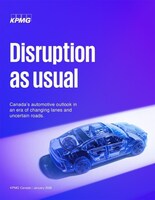
"We're seeing a foundational and irreversible transformation underway in the Canadian auto sector," says Dave Power, Partner and National Automotive Sector Leader at KPMG in Canada. "The implications down the supply chain and across the economy will be significant, but the industry, especially the more established players, have dealt with high levels of disruption before. That doesn't make the current tariff environment easier, it just once again calls upon the resiliency the industry has built up to be put back into action.
"From our recent survey and in conversations with automotive leaders, parts suppliers, and dealers, it's clear significant activity is underway to optimize their operations and explore new markets, partnerships and opportunities," he adds.
As the industry gears up for this week's Canadian International AutoShow, 17 per cent of OEMs and parts suppliers and manufacturers say they will be "completely transformed" over the next three years, 12 per cent say they will either be acquired or go through a consolidation. Nearly one in five (19 per cent) say they've been minimally affected, and only nine per cent say they are at risk of failure.
Supply chains and costs dominate the agenda
As uncertainty persists, Canadian auto leaders are prioritizing operational stability. Reinforcing supply chains and securing raw materials ranked as the top priority for manufacturers and suppliers over the next three years, followed closely by boosting productivity and optimizing costs, the report says.
The data shows these shifts are already underway:
- 82 per cent of manufacturers and suppliers are actively adjusting their supply chain strategies
- 70 per cent are exploring international markets
- 26 per cent saying new regional alliances will be critical to their success over the next three years
- 63 per cent have increased their prices in response to the tariff environment
- 62 per cent have "substantially changed" their product mix to reduce exposure to the tariff environment
- 69 per cent are investing heavily in AI and emerging technologies
- 70 per cent have achieved or surpassed their technology adoption targets
- 20 per cent report AI-related productivity improvements of more than 25 per cent
- 44 per cent believe advanced technology and software integration to be the biggest opportunity for the Canadian automotive sector in the next three years
- 38 per cent say building a domestic battery supply chain is among the biggest opportunities for the sector in the next three years
"Canada's automotive industry is under intense cost pressure from U.S. tariffs on car parts, steel and aluminum. The leading auto sector players aren't just managing disruption on the U.S. border; they are also looking to new markets that can offer greater trade certainty. It's worth remembering that Canada has 15 free trade agreements with 51 countries covering 1.8 billion people and 60 per cent of the world's GDP," says Joy Nott, Partner Trade & Customs, KPMG in Canada.
Ms. Nott adds that any new players entering the electric vehicle (EV) market could impact the automotive industry's competitiveness, creating additional challenges. "The big unknown is whether new EV players will invest and commit to manufacture in Canada," she says.
The tariff environment requires manufacturers to track the origin of every component embedded in whatever crosses the border, adds Tim Webb, Partner, Supply Chain & Procurement, KPMG Canada. "That has created a massive data challenge that manufacturers are trying to solve through investments into data and analytics, more targeted strategic sourcing, or both," he says.
The KPMG report also notes that the industry can expect further consolidation and integration. Key players may need to invest directly into suppliers and independent vendors to support them through this period of continued turbulence, the report says.
"Right now, a lot depends on where manufacturing investments flow. Suppliers need to stay close to those manufacturing plants, so until the OEMs really solidify their plans, I don't expect to see many Canadian-based suppliers make any big changes. For those with capacity on both sides of the border, it might be a different story as some start to play with their production allocations to reduce their exposure to tariff-related costs and complexities," adds Mr. Webb.
Dealers face mounting pressures
Auto dealers are also bracing for deeper structural change, the report says. Ninety-six per cent of dealers expect supplier consolidation within the next five years, 92 per cent expect a decline in brand and design relevance, and 90 per cent expect increased regionalization of the automotive industry, as sales shift online and EVs require less after-sales service. As many as 84 per cent believe new market entrants will replace traditional OEMs, with China leading the EV market.
"Dealers are trying to work out how to remain relevant to customers as auto sales move online and EV powertrains require substantially less after-sales service," says Mr. Power. "It will be extremely important, particularly for dealers, to plan for multiple scenarios. Focus on 'no-regret' moves such as divesting non-core assets, like extra lots or warehouses, strengthening supplier relationships, investing in productivity-enhancing technology and embracing digital, service-focused and hybrid models like agency sales or hub-and-spoke retail will be key."
In a recent KPMG survey of 2,000 Canadians, more than half (55 per cent) believe Canada could become a global leader in EVs in order to reduce its reliance on the U.S. auto industry, and nearly as many (52 per cent) expressed a desire for governments to make this a priority. Nearly half (47 per cent) indicated their support for removing tariffs on EVs from China.
About KPMG in Canada
KPMG LLP, a limited liability partnership, is a full-service Audit, Tax and Advisory firm owned and operated by Canadians. For over 150 years, our professionals have provided consulting, accounting, auditing, and tax services to Canadians, inspiring confidence, empowering change, and driving innovation. Guided by our core values of Integrity, Excellence, Courage, Together, For Better, KPMG employs more than 10,000 people in over 40 locations across Canada, serving private- and public-sector clients. KPMG is consistently ranked one of Canada's top employers and one of the best places to work in the country.
The firm is established under the laws of Ontario and is a member of KPMG's global organization of independent member firms affiliated with KPMG International, a private English company limited by guarantee. Each KPMG firm is a legally distinct and separate entity and describes itself as such. For more information, see kpmg.com/ca.
For media inquiries:
Sonja Cloutier-Bosworth
National Communications and Media Relations
KPMG in Canada
(416) 777-8175
(416) 528-5324

SOURCE KPMG LLP

